Watercolor Cups and Flowers: Vintage Cup Design Assets
Understanding the Aesthetic Appeal
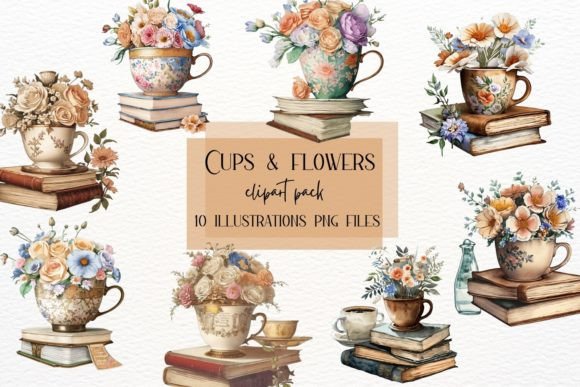
The "Watercolor Cups and Flowers" collection represents a specific intersection of traditional illustration and modern digital utility. At its core, this set offers ten distinct vintage cup illustrations rendered in a watercolor style. The visual personality of these assets is defined by soft edges, color bleeds, and the textured transparency inherent to watercolor media. Unlike vector graphics, which rely on solid mathematical lines, these illustrations possess an organic warmth. The vintage cup motif suggests a connection to nostalgia, tea culture, and domestic comfort. This style avoids the cold precision of geometric sans-serif typography or the rigid structure of modern UI design, instead opting for a hand-crafted feel. The appeal lies in the imperfections—the way pigment pools in corners and fades at the edges—which creates an immediate sense of authenticity. For designers working on projects that require a human touch, such as boutique branding or artisanal packaging, this aesthetic bridges the gap between digital efficiency and analog charm.
Strategic Applications in Branding and Marketing
While often categorized simply as "design assets," illustrations like these function as core components of a brand identity. In the crowded landscape of web design and social media graphics, generic stock photography often fails to capture attention. A cohesive set of watercolor illustrations can transform a standard marketing campaign into a curated visual experience. Consider the practical application for a small business owner in the food and beverage industry. A local tea shop or a ceramicist could utilize these vintage cup illustrations to create a consistent visual language across packaging design, menu layouts, and Instagram posts. The transparent PNG format is critical here; it allows the watercolor elements to be layered over various textures or solid backgrounds without the clunky white boxes often associated with lower-quality assets.
Beyond the beverage industry, these assets serve editorial design needs effectively. Bloggers and publishers focusing on lifestyle, home decor, or self-care can use these images to break up text-heavy pages. Instead of relying solely on typography to guide the reader's eye, a vintage cup illustration can act as a visual anchor. In marketing, visual hierarchy is paramount. A large watercolor illustration can draw the eye to a specific call-to-action or a featured product review. For entrepreneurs, the ability to customize these assets is a significant advantage. Because the files are high-resolution (300 dpi) and individually saved, they can be cropped, resized, or color-adjusted to fit specific campaign needs without pixelation. This flexibility makes the collection a practical investment for long-term content creation.
Integrating Illustrations with Typography
One of the most common challenges in graphic design is balancing imagery with text. The "Watercolor Cups and Flowers" collection pairs well with specific typographic choices. Because the illustrations are organic and flowing, they generally complement serif fonts and script fonts that share a similar sense of movement. For instance, pairing a vintage cup image with a refined handwritten font for a header can create a cohesive, artisanal look for a bakery logo or a wedding invitation. Conversely, mixing these soft illustrations with a clean, geometric sans serif font creates a modern contrast. This juxtaposition—organic art meets structured text—is a hallmark of contemporary logo design and layout. It signals to the viewer that the brand is both approachable (via the art) and professional (via the clean typography).
When evaluating how these assets influence readability, it is important to treat them as accents rather than backgrounds. Placing body text directly over a complex watercolor illustration can reduce legibility. Instead, experienced designers often use these images as standalone elements or place them adjacent to text blocks to provide visual breathing room. In digital applications, such as website headers or email newsletters, the vintage cup imagery can soften the rigid grid structures often found in web design. This helps in reducing visual fatigue for the reader. For content creators, the consistency of the collection is a key benefit. Using the same stylistic set across multiple posts or products ensures that the audience recognizes the brand's aesthetic immediately, fostering brand loyalty and professional recognition.
Practical Considerations for Project Fit
Selecting the right design assets requires a pragmatic assessment of the project's goals. The "Watercolor Cups and Flowers" set is specifically tailored for projects where warmth, nostalgia, and a feminine or artisanal touch are desired. If the project requires a futuristic, industrial, or hyper-minimalist aesthetic, these assets would likely clash with the intended message. However, for creative font pairings and commercial font projects in the lifestyle sector, they are highly effective. The technical specifications—1500px resolution and 300 dpi—make them suitable for both screen and print. A crafter could print these designs onto transfer paper for physical goods, while a digital marketer could use them for high-resolution web banners.
When incorporating these into a workflow, it is advisable to test the illustrations against the project's color palette. While the watercolor style is versatile, the specific hues in the collection should harmonize with the brand's primary colors. If the brand uses neon greens and electric blues, a vintage, earth-toned watercolor cup might feel out of place unless intentionally styled as a contrast piece. Ultimately, the value of this collection lies in its specificity. It offers a high-quality, ready-to-use solution for a defined aesthetic niche, saving designers and business owners the time and expense of commissioning custom watercolor artwork. By treating these illustrations as strategic brand identity tools rather than mere decoration, creators can significantly enhance the emotional resonance of their projects.