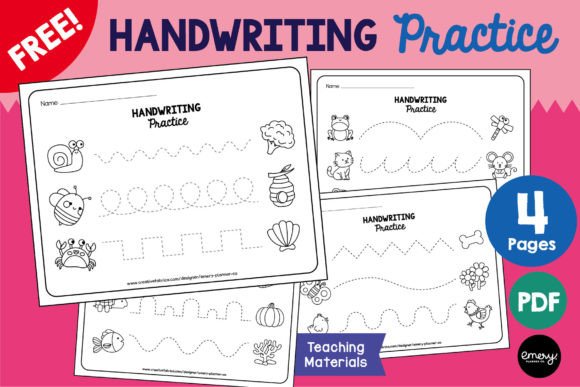
Handwriting Practice Worksheets | Lines for Fine Motor Skills
Building a Foundation with Purposeful Practice
In the digital-first world of design, marketing, and content creation, the human touch often gets lost. We spend hours perfecting kerning in premium fonts, selecting the ideal serif font for a brand identity, or debating between a modern sans serif and a classic script font for a logo design. Yet, the fundamental skill that underpins all great typographic appreciation—handwriting—is frequently overlooked. This is where practical tools like Handwriting Practice Worksheets | Lines come into play, offering a tangible bridge between raw motor control and the refined art of letterforms.
This free printable set is not a creative font itself, but rather a foundational design asset. It comprises four worksheets specifically engineered to develop fine motor skills through the simple, meditative act of tracing dotted lines. The visual style is intentionally minimal and functional: black and white, presented on standard 8.5x11 inch dimensions. This clean, distraction-free format is its strength. It strips away the complexity of full letterforms, focusing a child's (or an adult beginner's) attention solely on the control of the hand, the pressure of the pencil, and the consistency of line. The personality of these worksheets is one of quiet support and practical utility, a foundational tool rather than a decorative endpoint.
From Tracing Dots to Typographic Insight
The value of such a resource extends far beyond elementary education. For the entrepreneur, crafter, or small business owner, understanding the mechanics of handwriting provides a deeper appreciation for the typefaces they choose daily. When you practice drawing lines—straight, curved, zigzag, and looped—you are deconstructing the very components of every letter in every font you use. This exercise builds an intuitive understanding of stroke weight, baseline consistency, and the natural flow that makes a handwritten font feel authentic versus one that feels stiff and automated.
Consider the applications in the real world. A content creator developing a personal brand might use a script font to convey elegance. By practicing basic strokes with these worksheets, they gain insight into how that font achieves its effect, leading to more intentional use in social media graphics or editorial design. A crafter designing packaging for homemade goods might pair a bold display font with a simple sans serif. The fine motor control honed through line practice can subtly improve their hand-lettering for tags or notes, adding a cohesive, professional touch to their product that reinforces their brand identity.
Practical Integration into Your Creative Workflow
Integrating Handwriting Practice Worksheets | Lines into a professional or personal project is straightforward. Its primary use is as a developmental tool. For designers and artists, it can serve as a warm-up exercise to loosen the hand before tackling intricate illustrations or hand-lettered logos. For publishers or educators creating activity books or early-learning content, these sheets are a ready-made component. They are a perfect example of a design asset that solves a specific, universal need—structured practice—without unnecessary embellishment.
When evaluating any project's typography, the principles learned here are directly applicable. Readability in web design or editorial layouts is compromised if the foundational shapes of letters are poorly formed. Visual hierarchy in marketing materials relies on clear distinctions between headline and body copy, a clarity that is instinctively understood by someone who has practiced the disciplined spacing of lines. The professionalism of a brand's touchpoints, from a business card to a website, is built on consistency, a skill first developed in the controlled repetition of tracing.
Choosing and Using Foundational Design Tools
Selecting the right tool for the job is a core tenet of any creative profession. While Handwriting Practice Worksheets | Lines is a specific, non-editable PDF, its principles guide how we evaluate other design assets. When choosing a commercial font for a client's brand identity, you assess its personality, its range of weights (the included styles), and its licensing. You test font pairings to ensure a serif font's formality complements a sans serif's modernity. You review readability at various sizes, just as you would evaluate the clarity of the dotted lines on these worksheets.
This resource is a reminder that the best design often starts with simplicity. It is not a flashy creative font for a poster, but a quiet, essential tool for building the manual dexterity and visual understanding that makes using those premium fonts more effective. For the designer, it's a back-to-basics exercise. For the entrepreneur, it's a way to connect more deeply with the visual language of their brand. For the parent or educator, it's a free, printable solution for skill development. In all cases, it underscores a valuable lesson: mastery of the basics, whether in drawing a line or kerning a headline, is what ultimately elevates the final work.